Arnold Spirit Junior was born with “water on his brain”
resulting in him having physical problems. He had to wear glasses, he was
skinny, had a big head and big feet. He also suffered from seizures, has a
lisp, and stutters when he talks.
The Absolutely True Diary of a Part-Time Indian is about
Arnold wanting to go off the rez (Spokane Indian Reservation) to attend school
at an all-white school so he doesn’t get killed on the rez. Arnold is
criticized, and deemed a traitor to the Indians. The novel goes through
Arnold’s life and the difficulties he must face with being an Indian, attending
an all all-white school and not really belonging to either place.
I would use The Absolutely True Diary of a Part-Time
Indian to analyze characters. Arnold changes throughout the story finding
his identity. I would have the students compare and contrast how Arnold felt
about himself in the comic he drew of himself at the beginning to how he feels
about himself at the end of the story.
I would have a lesson on stereotypes for this book as well.
There are a lot of stereotypical statements in this book about poor people,
rich people, Indians, and in chapter one retards because of how he looks. I
would teach the students labels, biases, and unfair judgments.
The students could also research the Spokane Indians before
reading to better understand the way of life for this tribe so that they could
better understand the novel.
There was a great quote in The Absolutely True Diary of a
Part-Time Indian, “Life is a constant struggle between
being an individual and being a member of the community.” I would have the
students analyze this quote and compare it to their own life struggles with
being an individual and doing what society expects of them.
Hazel has been living with cancer since for a few years now,
and has come to terms that she is dying.She attends a support group for adolescents that have cancer. During one
session of the support group she meets a young man named Augustus Waters.Augustus, another teen who has cancer, will
change Hazel’s life forever taking her on adventures she never knew, including
falling in love. The Fault in Our Stars takes you on a journey through
adolescents having cancer, and how they find love and live their lives.
I read The Fault in Our Stars last May, and fell in
love with the story. I cried my eyes out the first time I read it, and I cried
my eyes out when I reread it today.
The Fault in Our Stars did remind me the support that
cancer patients have. The support groups like Hazel visits. Also how they have
a cancer team in the story where they meet to see how the fight against cancer
is going, or suggestions in treatment plans.
The Fault in Our Stars was made into a movie, which I
have not seen. In a book this great, I do not need a movie putting it to life
because it was already alive in my mind. You could have the students compare
and contrast the movie and the book though.
The Fault in Our Stars has amazing vocabulary. There
were words that I did not know the meaning to, and I would have to look up the
definitions. You could teach vocabulary and context clues.
The characters in the story I felt were well-developed
characters, and they each had their own unique personality. You could have the students
interview a character. They could create questions, and then answer based on
how the students felt that the characters would answer. This would show how the
students interpreted the characters.
The students could also write a eulogy for Augustus and
Hazel based on their characters in the book. This would show how they
interpreted the characters as they read the book.
When You Reach Me is about a girl named Miranda, who
begins to receive notes from an unknown person leaving her clues about what she
needs to do, and things she needs to record. The whole story I was confused.
You do not know who is sending the notes. The person knows things that nobody
should know. Miranda is confused, and trying to figure out how to prevent this
bad thing the notes are talking about from happening. I thought the worst when
these notes started coming, but man is there a twist. I did not see this coming
until I was in the last few chapters of the book.
When You Reach Me could be used in 5th
grade and above.
The book starts in the middle of the events coming to play
at the end. It then goes back to the beginning, and tells the story all the way
through. Students could make a timeline of the events that happened. Then they
can analyze the events in the book, and determine if it would influence the way
the book is told if the events happened in order. Also they could discuss why
the book works with the events not in order.
When You Reach Me mentions the book A Wrinkle in
Time throughout the entire book. Students could compare and contrast the
two books after reading them both.
The book is about time travel. Students can
research Stephen Hawking’s theory on time travel, as well as what Albert
Einstein had to say about time travel. They could compare Stephen Hawking’s
theories to When You Leave Me, and what Marcus, Julia, and Miranda talk
about. Then they can write about whether they agree or disagree with whether
time travel is possible, and their thoughts on the two scientists theories on
time travel.
NOVA Online has a good website discussing time travel here is the link: NOVA Online Time Travel
Sixteen-year-old Steve Harmon was in the wrong place at the
wrong time. He is in jail on trial for the robbery and murder of a drugstore
owner in Harlem, a part of New York that has a high crime rate. The prosecutor
deems Steve as a “Monster” because of the events that took place on December 22
at the drug store. The prosecutor has built a case that she feels that she can
win. Steve feels that his attorney does not believe him that he is just another
case for her. Steve knows and believes in his innocence.
The reader can relate to Steve all throughout the trial. His
fears of being in jail, his belief in his innocence, and the worry about if he
will be spending the next 25 years to life in jail for something he knows that
he did not do.
Walter Dean Myers did not write Monster in a typical
novel fashion. He wrote this story like a screenplay being told my Steve
Harmon. It was an interesting way to read the story. Monster was a not a
bad book, but there were parts that were hard to get through just because it
was kind of dry.
A social studies lesson could be taught with the novel
Monster. Most of the book takes place in the courtroom for Steve’s trial. The
students could determine if Steve was given a fair trial. You could even have a
mock trial about Steve’s innocence.
For a writing aspect, you could have the students write
closing arguments for one of the lawyers based on how the students interpreted
the story.
Students could analyze the characters in Monster to
determine who the true monsters in the story are.
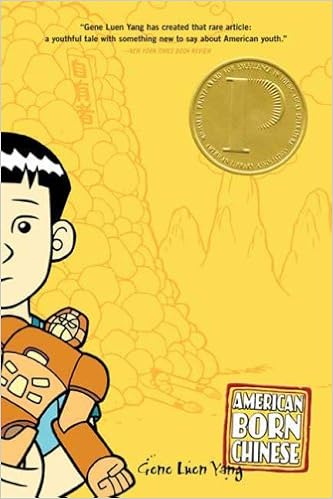
Jin Wang wants more than anything
to fit in with his all-American classmates. When his family moves, and he has
to attend a new school, Jin Wang discovers that he is the only Chinese-American
student at his new school.The teacher
didn’t introduce him correctly to the class, his classmates made fun of him.
Jin Wang befriends another Asian-American boy, Wei Chen. Together they struggle
with being two of three Asian-American students attending this predominately
all-American school. Jin Wang then falls for an All-American girl, and wants
nothing more to just like everyone else.
The monkeys of the world flocked to
the great Monkey King of Flower-Fruit Mountain. He was a good leader of the
monkeys, until he no longer wanted to be a monkey because of one fateful
incident. The Monkey King made some bad choices because no longer wanting to be
a monkey that he was buried under a mountain of rocks. He finally learned his
lesson about being true to your character from a disciple of Tze-Yo-Tzuh, and
helped the disciple with his journey.
Danny wants more than anything to
just be a popular kid who plays basketball, but that all changes for Danny when
Chin-Kee shows up. Chin-Kee comes and acts like a normal Chinese boy and Danny
feels that he is ruining his life. Danny finally confronts Chin-Kee when Danny
finds him dancing on a table in the library.
After the confrontation between
Danny and Chin-Kee all three stories become one. The characters learn how to be
true to their character, and value where they come from.
I cannot say that I loved this
book; actually I cannot say that I even really liked this book. It was a
struggle to get through. I just wanted the book to be over so I could move on
and not pick it up again. Thankfully the author chose to write it as a graphic
novel, otherwise it would have been turned it back into the library without
being fully read. Graphic novels are a fun alternative to reading a book for
me. I do not read a lot of them, but I have students who love them. It is
important to offer a different style of writing to the students in your
classroom.
Even though it was not my favorite
book, I would use American Born Chinese in a high school classroom (9th
grade and above).
There were a lot of good examples
how sometimes we judge people based on where they come from, and it does not
give us a fair picture of who they really are. I would have the students find
stereotypes in current events that were happening in our society, and relate
them back to the graphic novel, making a text-to-world connection. I would also
have the students make a text–to-self connection when someone judged them based
on their looks, culture, or any other thing.
American Born Chinese has a
theme of accepting who you are, as well as accepting others. I would do a
project with the students about finding out were their ancestors came to
America from. This would show the students that they all have different
backgrounds, and it is important to appreciate where you come from.
I would teach students about
different myths/legends. I would have the students’ research different myths
and legends about stereotypes and accepting oneself, that way it stayed with
the theme of American Born Chinese.
I would also use the graphic novel
to teach about different writing styles, and have the students create their own
graphic novel about stereotypes, and accepting yourself. This would add in some
art to your lesson.
Please Ignore Vera Dietz is heartbreaking, sad, and
left me wanting to cry at times. It is a story that could happen with students
today unfortunately, and I kept thinking about how real this could be for some
young adults.
http://www.amazon.com/Please-Ignore-Dietz-
Vera Dietz and Charlie Kahn have been best friends since
they were little. They are secretly in love with on another, but both are
affected by the actions of their parents. Their parents’ actions make them not
want to openly love one another because they are trying to avoid their destiny.
Vera not wanting to turn out like her ex-stripper mother who got pregnant at
seventeen or her alcoholic father. Charlie does not want to become his abusive
father.
Vera and Charlie’s relationship begins to change once they
enter high school. Charlie changes their friendship entirely when he becomes
friends with the “Detentionheads”, a group of kids who drink and do drugs. A
series of events leads to one fateful night were a lot of different things come
to play, but only Vera knows the truth of that night.
Nine months after that tragic night that took Charlie’s life,
Vera is trying to live her life. She is struggling with not to allowing her
destiny of becoming like her parents come true. Vera is struggling with the
death of Charlie, and having a hard time moving on because Charlie is showing
up everywhere to her. Vera is also struggling with taking the secrets to the
police in order to clear Charlie’s name, and allow to finally allow the truth
of that night come out.
The story goes back and forth between present time, and the
past that led up to Charlie’s death. Mainly Vera narrates the story, but there
are chapters where Charlie after he dies, Vera’s dad, and the Pagoda (a
landmark in the book where the kids hang out) also tell the story from their point
of view. The different characters telling parts of the book helps you
understand the different characters. It helps you understand the hatred Vera
feels for Charlie, but also why she loves him. Charlie’s point of view really
helps you understand his character, and how is parents’ behaviors affect how he
acts with Vera.
Please Ignore Vera Dietz discusses death, teen
pregnancy, underage drinking, drugs, pedophiles, sex, and has bad language.
I enjoyed reading Please Ignore Vera Dietz; it was
very insightful to me as an adult.
Please Ignore Vera Dietz would be excellent to teach
students about loss, and coping. Vera lost her mother (because she left) and
her best friend. n high schools’ today
children unfortunately lose their lives leaving behind their friends.
The novel would also be used to help students understand the
issues that come with drinking. I would have them research how alcohol is
dangerous. How much of an addiction alcohol can become, and affect their bodies
and lives.
There are different points of view in this story from the different characters. The
students would look at the different points of view in the book, and compare
and contrast how each character is seeing the same events in different
ways.
The students would also look at how the book is centered on
not becoming their parents. The students would find events in the book that
have Charlie and Vera acting like their parents.